
A few moments ago, I heard an Adobe advertisement on television promoting another AI addition to its software suite. Of course it was AI. Everything is AI now.
Your website builder is AI. Your email software is AI. Your accounting platform has an AI assistant. Your CRM has an AI copilot. Your hosting company wants AI to build your website. Your design software generates images, removes backgrounds, rewrites headlines and probably wants to make your morning coffee.
Every software company seems to have reached the same conclusion: if a product does not have an AI feature, an AI button or at least an AI paragraph on the sales page, it risks looking old-fashioned.
Some of these capabilities are genuinely impressive. Some are useful improvements to existing products. Some are old features that computers have performed for a decade or longer, moved into a new menu and presented as part of the AI revolution. And some are little more than a familiar product with a generic chatbot stuck to the side.
For a time-poor Australian small-business owner, the result is a mess.
You are told that AI will transform your business, replace half your workload, create your marketing, build your website, answer your customers and uncover opportunities you never knew existed. Then you try the product and discover that it cannot handle one of the basic things your business actually needs.
That is not transformation. It is often just marketing.
The useful conversation is not about whether you have "adopted AI". It is about where your business is losing time, leads, money or customer goodwill, and what combination of people, automation and sometimes AI can stop that leakage.
TL;DR for time-poor business owners
- "AI" is now such a broad marketing label that it tells you very little about whether a product will help your business.
- Do not buy a tool because it is AI-powered. Buy or build a solution because it solves a defined problem and produces a result you can measure.
- Much of the most valuable work for small businesses is automation: connecting systems, moving information, triggering follow-up, reducing double handling and making sure important tasks do not fall through the cracks.
- AI becomes powerful when it enhances a well-designed process. It can interpret an email, summarise a document, classify an enquiry or draft a response. Dependable automation should control what happens next.
- AI-generated marketing has created a sea of sameness. Producing more content is not the same as earning more attention.
- Humans are still essential for judgement, relationships, exceptions, accountability and understanding how the business really works.
- The best first question is not "How can we add AI?" It is "Where is the business currently wasting time or missing opportunities?"
What does "AI" even mean anymore?
Artificial intelligence is not one product or one capability.
The term now covers an enormous range of technologies. At one end, we have genuinely generative systems that can create and transform text, images, audio, video and code. We have models that can interpret unstructured information, find patterns in large data sets and make predictions.
We also have machine learning features that have been quietly operating for years: spam filters, product recommendations, fraud detection, photo recognition, predictive text and search ranking.
Then there is conventional automation: when this happens, do that. A form is submitted, so create a contact. An invoice becomes overdue, so send a reminder. A customer selects a service, so route the enquiry to the appropriate team member.
That may not involve AI at all. It does not need to.
Finally, we have ordinary software capabilities that have been swept under the AI umbrella because the label attracts attention.
Adobe provides a wonderful illustration of how broad the category has become. Its Australian website advertises "over a hundred AI features" and openly notes that the collection stretches from AI features introduced more than a decade ago to its latest releases. The catalogue places genuinely generative tools alongside familiar features such as Content-Aware Fill, Smart Objects, background removal and even QR code generation.
Adobe does have genuine generative AI. Firefly can create and modify images, video and other media, and its newer assistant is designed to coordinate work across multiple Creative Cloud applications. That is real capability.
But a QR code generator appearing in an AI feature catalogue also captures the absurdity of the moment.
The label has become so elastic that a customer can no longer assume "AI-powered" means new, intelligent, autonomous or even particularly useful.
"Is it really AI?" can be an interesting question. "Does it improve the business?" is a much better one.
The great AI labelling scramble
It is not difficult to understand why companies are doing this.
Customers are interested in AI. Investors expect an AI strategy. Executives do not want their business to appear behind the market. Product managers need new features to announce, and marketing teams need fresh reasons for customers to upgrade.
Adding an AI assistant is visible. Improving the unglamorous workflow underneath a product is often invisible.
So we get copilots, assistants, generators and "magic" buttons everywhere. Sometimes they save time. Sometimes they are a thin interface over a general-purpose language model. Sometimes they give the marketing department a headline without giving the customer a meaningful new outcome.
This is where AI marketing becomes lazy.
Instead of beginning with a customer problem, companies begin with the label. They ask, "Where can we put AI?" when they should ask, "What is frustrating our customers, and how can we fix it?"
The result is a strange kind of product development by press release. The existence of the feature becomes more important than its usefulness.
For a small business, that is dangerous because every new tool brings a cost. There is the subscription, certainly, but also setup time, staff training, duplicated data, privacy risk, another login, another integration and another process that may stop working at the worst possible moment.
An AI feature is not free simply because it is included in software you already use. It still consumes attention.
AI fatigue is real
The fatigue is not limited to business owners being asked to trial another platform. Customers are also drowning in the output.
AI has made it extraordinarily easy to generate a flyer, an email campaign, a social post, a blog article, a sales message and a polished image. That sounds like a gift to small businesses with limited marketing resources.
Used thoughtfully, it can be.
But when every business can produce ten times as much material, customers do not suddenly gain ten times as much attention.
Instead, their filters become more aggressive.
We now see the same shiny flyer, the same suspiciously perfect people, the same generic headline and the same breathless vocabulary everywhere:
Unlock. Elevate. Revolutionise. Harness. Transform. Supercharge.
No clear point of view. No specific insight. No evidence that the person publishing it understands the customer. Just competent-looking material assembled in seconds and pushed into an already crowded world.
Most people are not reading it.
Worse, resistance is growing. People are becoming wary of content that feels synthetic, generic or careless. They know when an email has been sprayed at a list. They recognise the five-paragraph answer that could have been written for any business in any industry. They scroll past the glossy flyer because they have seen essentially the same one twenty times this week.
AI has reduced the cost of producing content. It has not increased anybody's obligation to consume it.
This does not mean businesses should never use AI to help create marketing. It means the human work has moved.
The blank page is no longer the hardest part. Judgement is.
Someone still needs to decide what is worth saying, contribute real experience, challenge the generic draft, remove the inflated language, verify every claim and make the result sound like a business with an actual personality.
If AI helps you say something worthwhile more clearly, excellent.
If it merely helps you publish more AI shite, you are not solving a marketing problem. You are adding to one.
AI website builders: generating pages is not the same as building a business asset
Website builders are a perfect example of the gap between the demo and the real job.
GoDaddy's Australian website tells visitors to describe their idea and says, "AI does the rest." Hostinger promotes AI-generated copy, images, product pages, logos and websites. These products can clearly help someone get a first draft online quickly.
That can be useful.
But a few generated pages are not necessarily a functioning business website.
I was reminded of this when I recently tested VentraIP's free VIPsites website builder. VentraIP's public page promises a "stunning, professional website in minutes" and says the product was designed with business needs in mind so a site "performs at its best".
My test hit a very basic wall: I could not implement the Google Analytics tags I needed, and I could not find a useful built-in website statistics alternative that would do the job.
To be clear, Google Analytics is not a legal requirement for operating a website. It is, however, a minimum practical requirement — or should have an equivalent — for a serious business that wants to understand and improve its online performance.
Without adequate measurement, how do you know:
- Where visitors came from?
- Which pages attracted attention?
- Whether advertising generated enquiries?
- Where potential customers abandoned the process?
- Which content contributed to a sale?
- Whether the new website performs better than the old one?
Google explains that measuring a website requires measurement code on its pages, and its advertising platform relies on website conversion measurement to understand actions such as purchases and sign-ups. That is not obscure enterprise functionality. It is fundamental to making informed marketing decisions. (Google Analytics setup, Google Ads conversion measurement)
VentraIP's builder is free, and a free tool naturally has limits. It may be perfectly adequate for someone who needs a simple online presence and nothing more. VentraIP is also well regarded for hosting and Australian support; this is not an argument that everything the company does is poor.
It is an argument about the difference between getting a page online and operating a business website.
A serious website may need analytics, advertising tags, conversion tracking, search optimisation, accessibility, redirects, structured data, CRM integration, reliable forms, booking logic, payment systems, privacy controls and the freedom to evolve as the business changes.
An instant builder might produce an attractive homepage. It cannot automatically understand which of those capabilities matter to your business, how customers make their decisions or where your sales process currently fails.
That is the part the "website in minutes" promise leaves out.
Stop asking whether a product has AI
When a vendor leads with AI, bring the conversation back to the business.
Ask:
- What specific problem does this solve?
- Who performs this work now, and how long does it take?
- What mistakes, delays or missed opportunities occur in the current process?
- Does this product work with the systems we already use?
- Can it handle our real exceptions, or only the perfect demonstration?
- What information will it collect, store or send elsewhere?
- What happens when the output is wrong?
- Can a person review, correct or reverse important actions?
- How will we measure whether it worked?
- Would a simpler automation be cheaper and more dependable?
If the vendor cannot describe the benefit without repeatedly saying "AI-powered", there may not be much of a benefit.
This is particularly important when customer or employee information is involved. The Office of the Australian Information Commissioner advises organisations to consider whether AI is actually the best solution, conduct due diligence, understand data flows, embed human oversight and regularly review whether a product remains fit for purpose. In wonderfully plain language, the regulator says AI products should not be used simply because they are available.
That should be printed above a few product-development desks.
Automation is often the real small-business superpower
The most valuable improvement in a business is rarely a clever standalone feature.
It is usually a connected process.
An enquiry arrives through the website. The details are checked and added to the right system. The prospect receives an immediate acknowledgement relevant to the service they selected. The appropriate person is notified. A follow-up task is created. If nobody acts within a defined period, the issue is escalated. The eventual outcome is recorded so the business can see which enquiries convert.
That is useful.
Some parts may use AI. A model might read a free-form message and determine whether it concerns sales, support or an urgent problem. It might summarise a long request or extract key details from an attached document.
But dependable automation should control the process around it: where the information goes, what conditions must be met, when a human takes over and how the result is recorded.
That combination can help small businesses across the full operation.
Leads and sales
- Capture enquiries consistently from websites, email, phone and advertising.
- Respond immediately without pretending a robot is a salesperson.
- Qualify and route opportunities using agreed business rules.
- Schedule useful follow-up instead of relying on someone's memory.
- Assemble proposals from approved products, pricing and terms.
- Show which sources and campaigns produce worthwhile customers.
Customer service
- Categorise incoming requests and send them to the right person.
- Suggest responses using approved information while keeping a person in control.
- Detect urgent language or repeat complaints for faster escalation.
- Provide proactive updates when an order, job or appointment changes.
- Identify recurring issues instead of solving the same symptom forever.
Administration and finance
- Move approved information between forms, CRM, accounting and project systems.
- Generate documents from controlled templates.
- Reconcile information and flag exceptions for review.
- Send courteous invoice reminders at the right time.
- Remove repeated copying, pasting and re-keying.
Operations
- Create jobs and allocate work when defined conditions are met.
- Alert the right person when a task stalls.
- Collect field information in a consistent format.
- Generate regular reports from real operating data.
- Surface bottlenecks before they become customer complaints.
Marketing
- Segment customers based on real behaviour and needs.
- Trigger relevant communication after meaningful events.
- Repurpose genuine expertise without flattening the brand's voice.
- Track enquiries and outcomes instead of celebrating impressions alone.
- Give people useful information at the point they are most likely to need it.
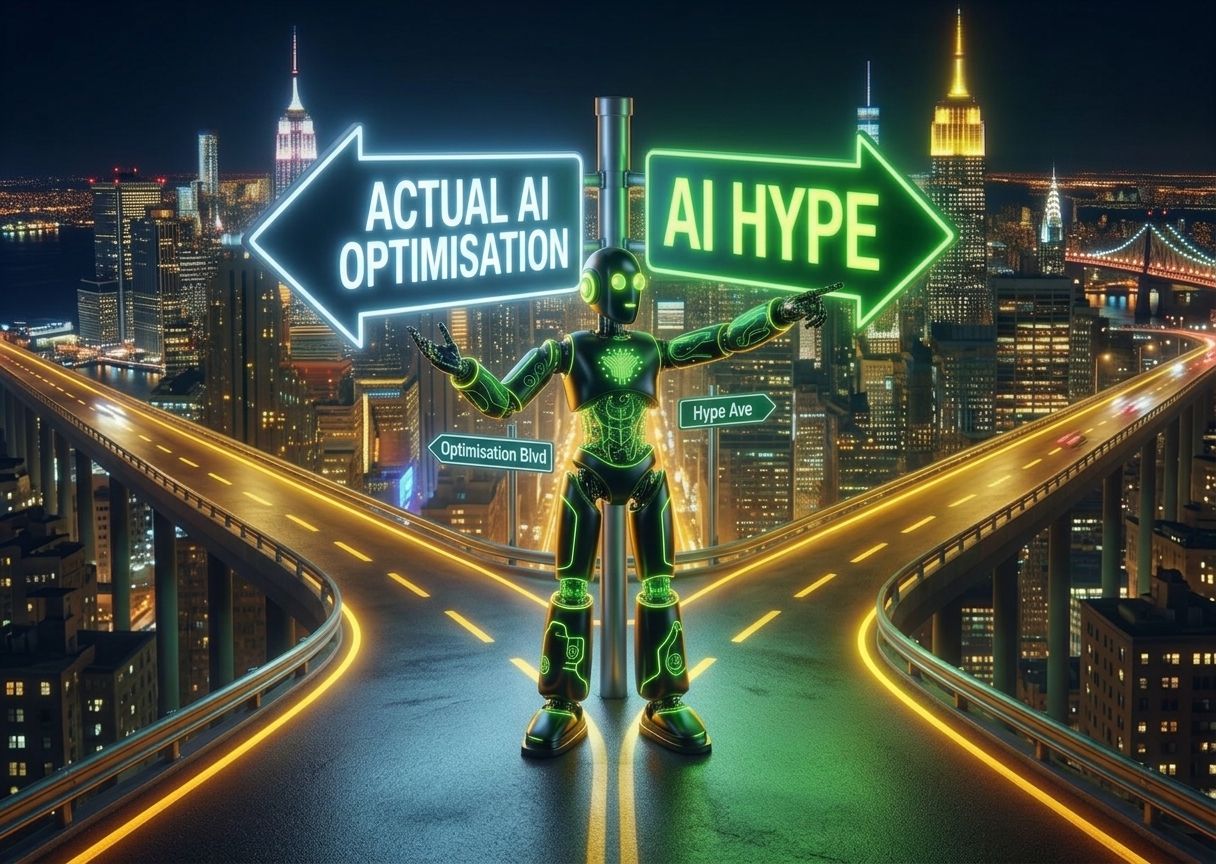
AI gimmick or useful business system?
| AI gimmick | Useful automation |
|---|---|
| Generates another generic social post | Follows up a genuine enquiry before it goes cold |
| Produces a website draft | Connects the website to measurement, CRM and the sales process |
| Adds a chatbot because competitors have one | Answers from approved information and escalates when uncertain |
| Summarises information nobody needed | Extracts the details staff currently re-enter by hand |
| Writes a polished paragraph | Removes a recurring bottleneck from the customer journey |
| Claims to transform the business | Produces an improvement the business can measure |
The difference is not always whether AI is present.
The difference is whether somebody understood the job.
Humans are still needed
This is where the next lazy promise usually appears: the autonomous business that runs itself while the owner relaxes on a beach.
It is a lovely advertisement. It is not how healthy businesses operate.
Humans are still needed to understand the problem, make trade-offs, handle exceptions, build relationships, apply empathy, approve sensitive actions and accept responsibility for decisions.
AI systems can be confident and wrong. They can misread context. They can generate plausible material that is not true. They do not know that a long-standing customer is having the worst week of their life, that a technically correct response will inflame a delicate situation or that an unusual order represents an enormous opportunity.
Good automation does not pretend these realities do not exist. It creates clear handover points.
The system handles the repetitive and predictable work. A person steps in where judgement creates value or risk requires accountability.
The best system is not necessarily the one that removes every human. It is the one that stops good people wasting their time acting like computers.
That might mean an employee no longer copies information between three platforms. It might mean a salesperson begins the day with qualified opportunities instead of an untidy inbox. It might mean the owner receives a useful exception report instead of spending Friday afternoon assembling a spreadsheet.
Those people have not become unnecessary. They have become more available for the work only people can do well.
Why off-the-shelf tools eventually hit a ceiling
Off-the-shelf products have an important place. They are affordable because they solve a common problem in a standard way.
But every business eventually discovers the gap between how software expects work to happen and how work actually happens.
The quoting platform does not understand the unusual approval step. The CRM and accounting package disagree about which record is authoritative. The booking tool cannot handle one high-value service. The AI assistant can draft a message but cannot determine whether sending it is appropriate. Staff create workarounds, spreadsheets and manual checks to bridge the gaps.
That is where consulting matters.
A capable consultant does not arrive carrying an AI product in search of somewhere to install it. The work begins by understanding the business:
- Where does work enter the organisation?
- Where does it wait?
- What information is entered more than once?
- Which tasks depend entirely on one person remembering them?
- Where do enquiries disappear?
- Which customer frustrations keep recurring?
- Which reports take hours to assemble?
- Where would faster action improve revenue, capacity or service?
Only then should anyone decide whether the answer is a configuration change, an integration, a conventional automation, a redesigned process, a custom system or an AI-enhanced workflow.
At momentuum, that is the level we care about most. We are not interested in adding AI theatre so a business can say it has adopted AI. We want to understand what will genuinely improve the operation and help implement it properly.
Sometimes the right answer will be a straightforward automation. Sometimes AI will provide the missing ability to interpret messy human information. Sometimes the business should fix the underlying process before adding any technology at all.
The tool is not the strategy.
A no-nonsense checklist before buying another AI tool
Before starting another free trial, ask these questions:
- Can we define the current problem in one or two sentences?
- Do we know what that problem costs in time, errors, delays, lost leads or customer frustration?
- Can the product demonstrate the entire workflow using a realistic example from our business?
- Does it integrate properly with the systems we intend to keep?
- Who owns the data, and where does it go?
- Are privacy, security and access controls appropriate?
- Can we review and reverse important actions?
- What happens when the system is uncertain or unavailable?
- Can staff understand and maintain the process?
- What result will we measure after 30, 60 or 90 days?
- Are we paying for a useful capability — or for the AI label?
If those questions feel less exciting than an AI demonstration, that is the point. Good systems survive contact with the real business. Bad ones survive only while the demonstration is running.
Cut through the hype and start with the business
AI is not magic, and it is not meaningless.
Generative and predictive systems can do things that were impractical for a small business only a few years ago. They can help interpret large amounts of information, make expertise more accessible, reduce the effort required to produce a first draft and add flexibility to otherwise rigid automations.
Used in the right place, that is powerful.
But the label has become too broad and too abused to guide a sensible investment decision. "AI-powered" does not tell you whether a product understands your business, works with your systems, protects your information or improves an outcome that matters.
The competitive advantage does not come from collecting the greatest number of AI subscriptions.
It comes from seeing the business clearly.
It comes from finding the repeated task that consumes hours every week, the slow response that costs good leads, the missing handover that frustrates customers, the spreadsheet that only one person understands or the disconnected systems that force staff to enter the same information again and again.
Then it comes from applying the right solution: human judgement, better process design, dependable automation and, where it genuinely adds value, AI.
Before asking how to "add AI" to your business, ask where time, leads, money and customer goodwill are currently leaking out. That is where the useful conversation begins — and it's the same question that underpins where automation is genuinely working for Australian small businesses today.

Want the real read on your business, not another AI pitch?
If you want to look past the hype and identify the changes that could genuinely move the needle in your business, talk to momentuum. We will start with how your business actually works — not with an AI feature we want to sell you.